
What is a double-wall shipping box?

Many sellers only start taking shipping boxes seriously after a few damaged shipments and bad reviews. Among the international trade customers I have worked with, about seven out of ten cannot tell the difference between single-wall and double-wall boxes, let alone flute types, paper weight, and ECT. When placing an order, the most common request I hear is, “Give me the strongest box.” A double-wall shipping box is actually quite straightforward. It uses two corrugated flute layers and three linerboard layers to form a five-layer structure, compared with the three-layer structure of a standard single-wall box. This gives the box better support and compression resistance, but thicker is not automatically better. Product weight, shipping distance, and stacking conditions are what really matter.
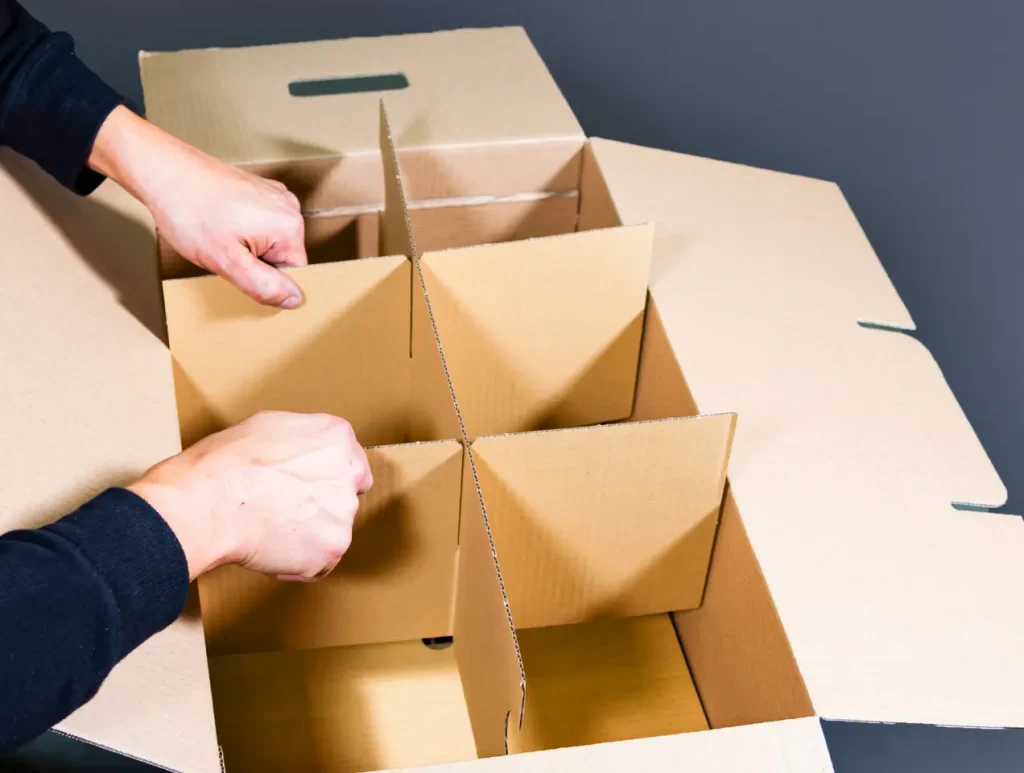
What Is a Double-Wall Shipping Box? How Is It Different from a Single-Wall Box?
A double-wall shipping box is commonly called a Double-Wall Shipping Box. It has two corrugated flute layers and three linerboard layers, while a single-wall box has one corrugated flute layer and two linerboard layers. When I source shipping boxes, I do not look at the words “single-wall” or “double-wall” alone. Even among double-wall boxes, different flute types can create noticeable differences in thickness and support.
- Thickness: BC-flute double-wall boxes are usually around 6–7 mm thick. C-flute single-wall boxes are about 4 mm, while EB-flute double-wall boxes are thinner at roughly 4–4.5 mm. If a customer simply tells me, “I need a double-wall box,” I will still ask which flute type they need.
- Strength: Single-wall boxes commonly use 32 ECT, while double-wall boxes commonly use 44 or 48 ECT. For goods that will be palletized, stacked, or stored for long periods, I pay more attention to ECT. If the product has sharp edges that could puncture the box, burst strength also needs to be considered. Some logistics applications involve a 200 lb burst-strength requirement.
- Load capacity: A single-wall box becomes something I would treat cautiously at around 10–15 kg, while a double-wall box can handle around 30 kg. If the product weighs more than 20 kg, I usually start with a double-wall option and then adjust the flute type and internal cushioning.
The real value of a double-wall box is the extra support it provides during compression, stacking, and handling. It is not simply about making the cardboard thicker.
What Products Are Suitable for Double-Wall Shipping Boxes?
When I help a customer choose a shipping box, I usually ask three questions: How heavy is the product? Will the boxes be stacked during transportation? How many times will the shipment be handled? Once these questions are clear, it is much easier to decide whether a double-wall box is necessary.
- Heavy products: Electronics, auto parts, tools, and mechanical components can place significant pressure on the bottom and side panels of a box. Once the product weighs more than 20 kg, I would be cautious about relying on a standard single-wall box.
- Fragile products: Glass, ceramics, and large bottles need stronger outer-box support. However, the double-wall box is only part of the protection system. Paper trays, honeycomb boards, foam, or other internal supports still need to be arranged properly. If the product moves around inside the box, even a strong box cannot prevent repeated impacts.
- Long-distance shipping: Ocean freight and cross-border transportation involve loading, unloading, handling, stacking, and sorting. As a box is handled repeatedly, its corners can gradually become softer and its original load capacity can decrease. This is where a double-wall structure becomes more useful.
- Light products: Clothing, books, stationery, and ordinary plastic products can often be shipped safely in a single-wall box with proper cushioning. Double-wall boxes may cost 30% to 100% more than single-wall boxes, and they are also heavier. For very light products, the extra box and shipping costs may not be worthwhile.
How Much Does a Double-Wall Shipping Box Cost? How Do Size and Order Quantity Affect the Price?
One of the easiest mistakes in box purchasing is judging the cost from the unit price alone. Once the box size changes, the price, weight, and shipping cost can all change with it. When I calculate packaging costs, I look at the box price together with the later logistics cost.
For a common 275 lb double-wall specification, a 20 × 16 × 16 inch box costs about $7.03 per box, while an order of 1,000 boxes can bring the price down to about $5.51 per box. If the size increases to 24 × 20 × 20 inches, the price is about $10.73 per box, or about $8.01 per box at 1,000 units. The first size has a box thickness of about 6.35 mm, while the larger box can have a dimensional weight of 80 lb.
| Item | Reference Data |
| 20 × 16 × 16 inch double-wall box | About $7.03/box |
| 1,000 units of the same size | About $5.51/box |
| 24 × 20 × 20 inch double-wall box | About $10.73/box |
| 1,000 units of the same size | About $8.01/box |
| Thickness of the 20 × 16 × 16 inch box | About 6.35 mm |
| Dimensional weight of the 24 × 20 × 20 inch box | 80 lb |
That is why I do not recommend comparing shipping boxes by unit price alone. Saving a few cents on the box can quickly disappear if the larger dimensions increase the dimensional shipping cost.
Four Common Mistakes When Buying Double-Wall Shipping Boxes
- Choosing “double-wall” without checking the flute type. EB-flute double-wall boxes are around 4–4.5 mm, while BC-flute double-wall boxes are around 6–7 mm. Paper specifications also affect actual strength. Simply asking for a “double-wall box” is not enough.
- Treating ECT and burst strength as the same thing. For stacking and palletized shipments, I focus more on ECT. For products that could puncture the box wall, burst strength matters more. A 275 lb double-wall box can have a maximum box-weight reference of 100 lb, with an 80 lb UPS recommendation. The two numbers may look close, but they address different packaging requirements.
- Assuming a double-wall box will prevent all damage. I have seen a seller upgrade to double-wall boxes and add honeycomb dividers, yet the damage rate still reached 7%. The problem turned out to be rough handling during last-mile transportation, while the internal fixing and cushioning were still inadequate. A stronger outer box does not stop the product from being repeatedly thrown around inside it.
- Assuming a bigger box is always better. This is another common idea. A 24 × 20 × 20 inch double-wall box can have a dimensional weight of 80 lb. If the product inside is light, extra empty space can push shipping costs higher. A shipping box should fit the product properly rather than simply being as large as possible.
Double-wall shipping boxes are more suitable for heavy goods, fragile products, long-distance shipments, and products that need to be stacked. Lightweight products do not automatically need to be upgraded just because a double-wall box is stronger. If the product weighs more than 20 kg, needs long-term stacking, or will go through repeated sorting, it makes sense to evaluate the double-wall structure along with the flute type, ECT, box dimensions, and internal cushioning. Giving the supplier these details before ordering is usually much more practical than simply asking for “the strongest box,” and it makes packaging costs easier to control.

